Oct. 16, 2025
Marcel Cornis-Pop, a leader in VCU humanities education, dies at 79
Share this story
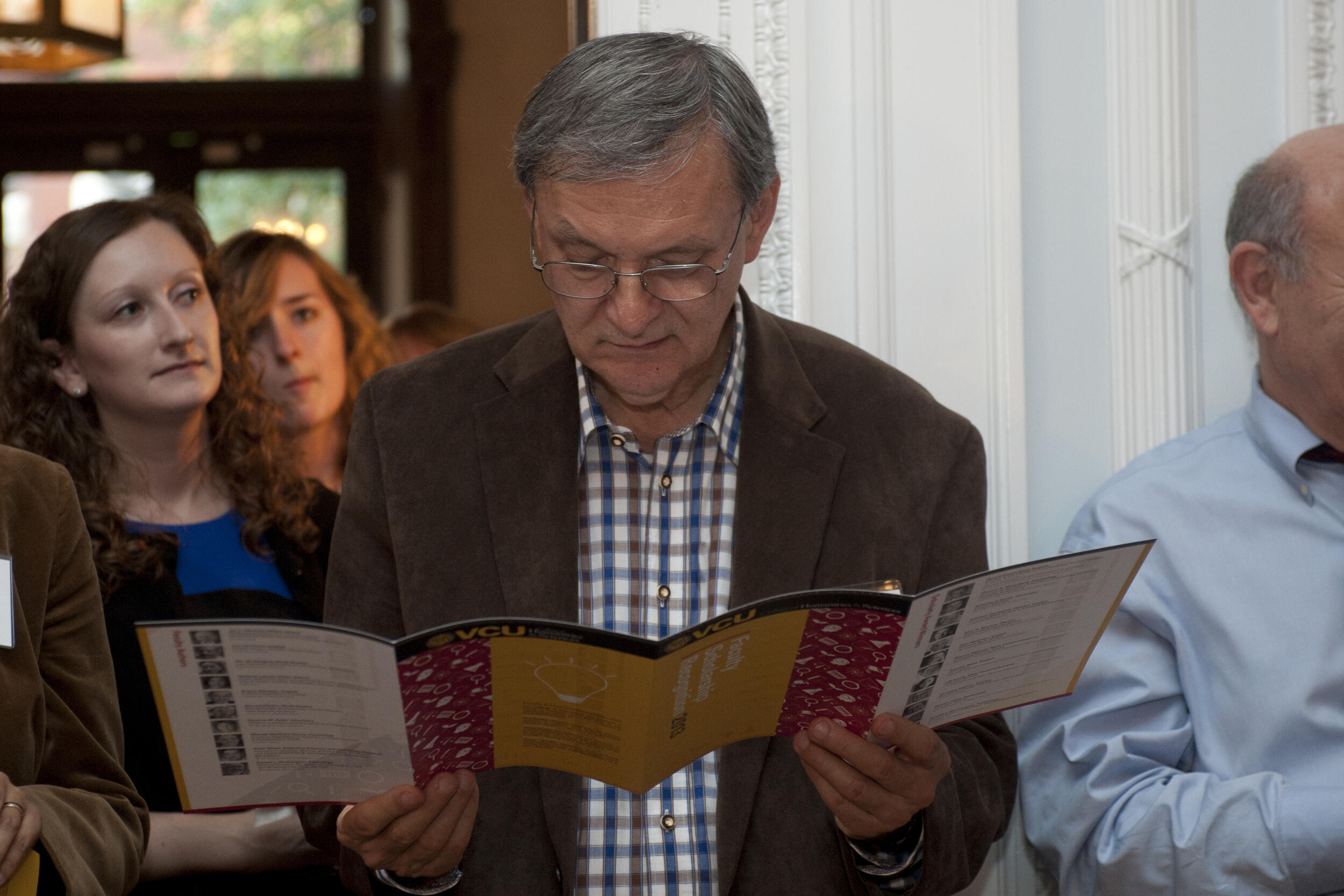
Marcel Cornis-Pop, the author, literary critic, theorist and educator whose ingenuity propelled interdisciplinary humanities education at Virginia Commonwealth University, died Sept. 23 at age 79.
When Cornis-Pop, Ph.D., arrived at VCU in 1988, his career in academia was already marked by excellence despite an ongoing struggle against censorship and suppression in his native Romania, then a communist state.
Before arriving at VCU, Cornis-Pop taught at universities in Romania and Iowa, where he was a Fulbright Scholar at the University of Northern Iowa, and then at Harvard University as an Andrew W. Mellon Faculty Fellow. He received his Ph.D. from the University of Timişoara and his master’s from Babeş-Bolyai University of Cluj, both in Romania, where he began studying English and literature in the fourth grade.
In Romania, he received the Romanian Writers Union’s Prize for translations that introduced the Romanian public to the works of authors such as J.D. Salinger, Kurt Vonnegut, Ken Kesey and Dylan Thomas, and his Ph.D. dissertation on Herman Melville and Thomas Wolfe became a book, “Anatomy of the White Whale,” that was awarded the union’s prize for literary criticism.
Longtime colleagues Richard Fine and David Latané, now faculty emeriti in the Department of English in VCU’s College of Humanities and Sciences, served on the search committee that hired Cornis-Pop.
Fine, Ph.D., recalled that they were “immediately impressed with Marcel’s intellect and accomplishments, and enthusiastic about what he could offer the department and its students.” He added that Cornis-Pop came across so intellectual and “cosmopolitan” that he and Latané needed to convince some colleagues that he would be able to relate to VCU students.
“I am so glad we prevailed,” Fine said. “No one contributed more to the department’s scholarly profile. No one relished new ideas with more enthusiasm. And no one communicated that enthusiasm to students more genuinely than Marcel.”
Cornis-Pop chaired the Department of English from 2000 to 2006. While his courses often covered difficult subjects, he endeavored to make them accessible to students at the undergraduate and graduate levels alike.
Among Cornis-Pop’s greatest contributions at VCU was the founding of the interdisciplinary doctoral program in media, art and text, which launched in 2006 and which he directed in its early years. At the time, he told prospective students that the program, which incorporates studies from the Department of English, the Richard T. Robertson School of Communication and the School of the Arts, would be “very uncomfortable,” challenging its scholars to think outside the box.
“Marcel was the first person I met on my on-campus visit to VCU, and his intellectual generosity, curiosity and unfailing collegiality then – and throughout his time at VCU – were unparalleled,” said Catherine Ingrassia, Ph.D., dean of the College of Humanities and Sciences.
She noted that his vision and commitment as department chair then extended to his leadership of the doctoral MATX program, which has become a model for interdisciplinary humanities scholarship.
“He understood that the future of humanistic inquiry required breaking down traditional boundaries between disciplines, and he dedicated himself to creating an intellectual environment where students and faculty could explore those intersections with rigor and creativity,” Ingrassia said.
She added that Cornis-Pop’s legacy lives on through the annual lecture series that is named for him, “ensuring that his deep influence on our academic community will not be forgotten.”
Cornis-Pop’s scholarly contributions include the four-volume “History of the Literary Cultures of East Central Europe,” co-edited with John Neubauer, and the books “Narrative Innovation and Cultural Rewriting in the Cold War Era and After” and “New Literary Hybrids in the Age of Multimedia Expression.”
“Literature remains an important window through [which] we peep at the world,” Cornis-Pop said in a 2017 Q&A with Romanian writer Constantin Severin., “But this window has to be continually refreshed and redefined, opening new vistas in the way we make and receive literature.”
“Marcel was brilliant and generous, but what stands out most was his remarkable capacity for work,” said Latané, Ph.D. “As a teacher, scholar and administrator, he gave his all, and he worked as hard to ensure his family was successful in America as well.”
“Often Marcel would express his gratitude to VCU for hiring him, and for allowing him to settle,” Fine said. “He had many opportunities to leave VCU … but never pursued them. I’m sure students sensed that in Marcel they had a teacher totally comfortable in his own skin and who truly wanted to be where he was.”
Subscribe to VCU News
Subscribe to VCU News at newsletter.vcu.edu and receive a selection of stories, videos, photos, news clips and event listings in your inbox.