Sept. 21, 2026
Gevick Safarians is building tiny worlds to fight a deadly cancer
Share this story
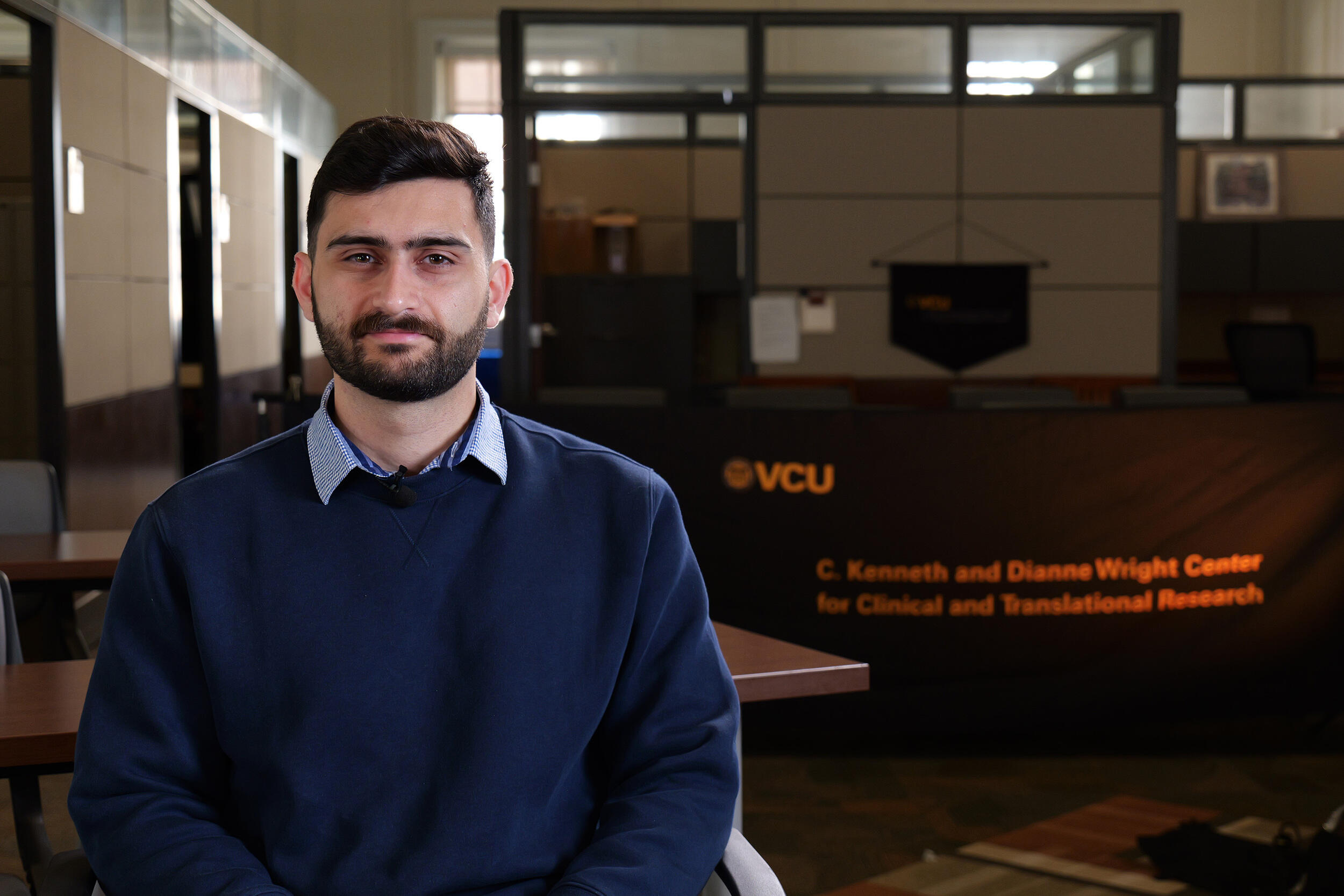
Gevick Safarians remembers the conversations. Patients dealing with cancer and other diseases with very poor prognoses, hoping not for years but for months — a little more time to settle their affairs, to figure out who would care for their pets. Those encounters stayed with him.
"Patients that are dealing with cancer deserve that added chance in life," said Safarians, a third-year M.D.-Ph.D. student in Virginia Commonwealth University School of Medicine’s Medical Scientist Training Program. "And I see myself, with my training, in a unique position to be that person for them."
That sense of purpose is what brought Safarians to the Wright Center's Translational Biomedical Sciences T32 Training Program, a federally funded fellowship supported by the National Center for Advancing Translational Sciences at the National Institutes of Health, that prepares predoctoral researchers to bridge the gap between laboratory discovery and patient care. As a T32 trainee, Safarians is doing exactly that: bridging engineering and medicine to bring the three-dimensionality of the human body into the lab, one controlled variable at a time.
A chip the size of a thumbnail
Safarians works in the lab of Priscilla Hwang, Ph.D., associate professor in the Department of Biomedical Engineering, in the VCU College of Engineering, whose research focuses on developing 3D microphysiological systems to study cancer progression and collective cell migration.
His focus within that work: metastatic prostate cancer, and the steep drop in survival odds that comes with it.
"Once it's localized and you're able to catch it early, you see about a 90 percent survival over the course of five years," Safarians explains. "But there are situations where metastasis can happen — and for those patients, unfortunately, five-year survival drops to just around 30 to 37 percent. And that's what's driving the need to create more therapeutic opportunities."
Part of what makes metastatic prostate cancer so difficult, Safarians said, is the sheer variety of environments the cancer passes through.
“It's very heterogeneous in terms of the environments it experiences in the body — starting from the prostate, then metastasizing through the blood, reaching places like the bone, liver or lungs,” he said. “All of these places have different landscapes, and in those landscapes there are many features that may be affecting the tumor: making it more metastatic, more proliferative or even treatment resistant.”
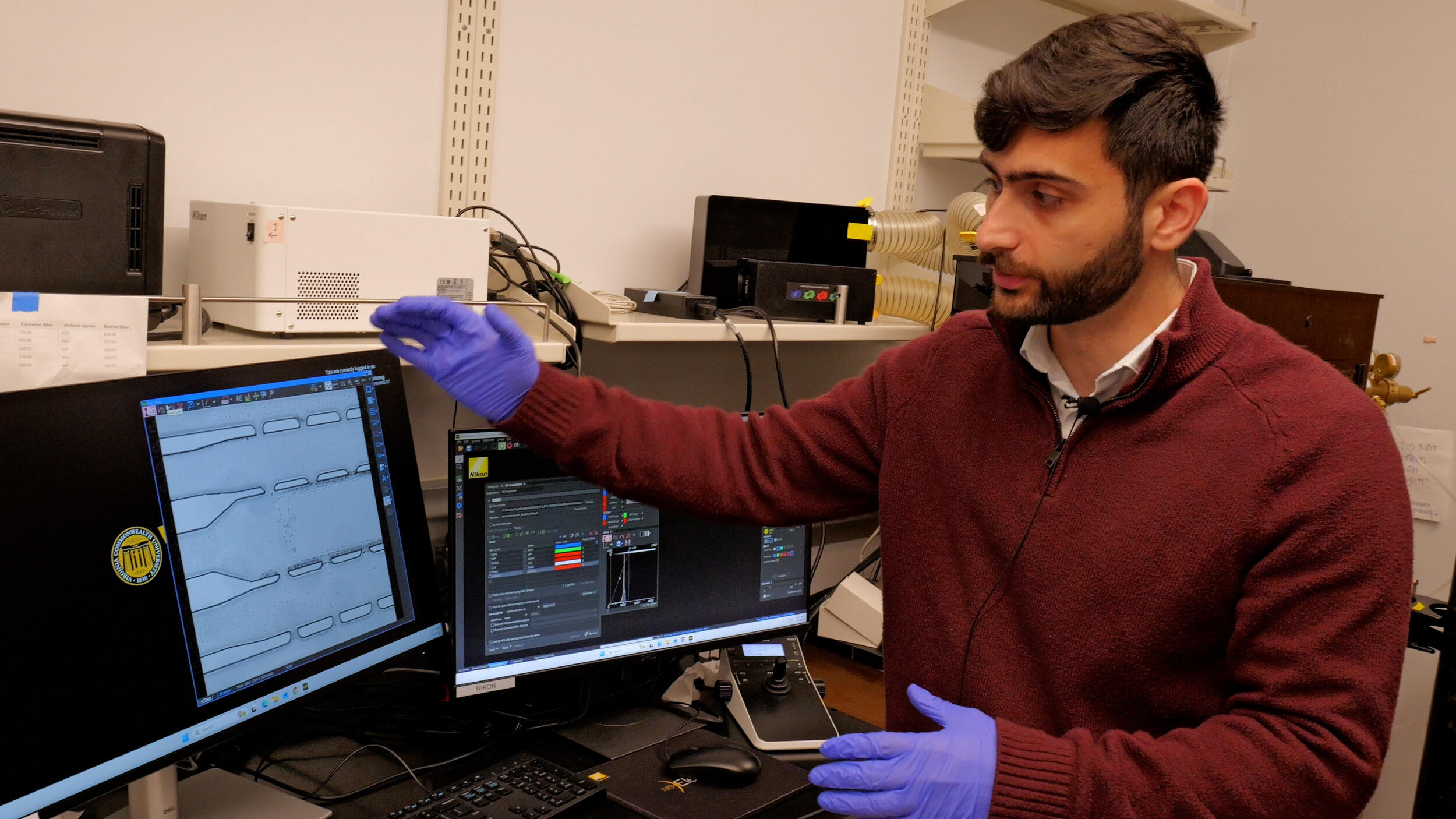
The microfluidic chip is designed to reckon with that complexity. Each chip is a small, hand-fabricated device containing channels about 100 microns wide, fine enough to flow fluid through, culture living cells in, and fill with hydrogels formulated to mimic the chemical and mechanical properties of real tissue.
“Outside of the body, we can try simulating pieces of these environments,” Safarians said. “With these simulations, we can have a better idea of what these effects may be doing to the cells, and that can help inform future therapeutics.”
Because the chip is mounted on glass, a microscope can capture live-cell imaging directly through the bottom, producing video of cells responding in real time to the conditions Safarians sets.
“The beauty of it,” he said, “is that we can take images of the cells, even videos, as they're undergoing these different cues we put them through.”
Simulating the journey
One dimension Safarians is especially focused on is fluid shear stress — the mechanical pressure cancer cells experience as fluid flows past them.
“In the blood, where there's a lot of flow, cancer cells can experience very high levels of shear stress,” he said. “But when they reach tissues like the bone or lung, these are much lower interstitial fluid velocities. With our microfluidic chip, we can simulate these different amounts of flow and study what kind of impact that has on the cancer cells themselves.”
The chips also let him vary the surrounding matrix — stiffness, fiber alignment, chemical composition — and to culture cells as three-dimensional spheroid clusters rather than flat layers.
“I like to say this is a step up from just hydrogels in isolation,” he said. “Microfluidics allow for that fluidic aspect of the microenvironment as well.”
Translational science, redefined
The Wright Center's T32 program is pushing Safarians to think beyond the bench. Through coursework in community-engaged research and team science, a clinician mentorship component focused on clinical trial design, and a community mentor pairing, the fellowship asks its scholars to grapple with a question that's important to keep front of mind in the lab: Who does this work ultimately serve, and are they part of the conversation?
“The definition of translational science is completely changing,” Safarians said. “Now we're seeing scientists and engineers trying to work with community members — teachers, coaches, religious leaders, community advisory boards — to help formulate research questions that are more applicable to the communities they hope to serve.”
That shift resonates with him. A breakthrough that patients don't trust or have never been asked about is a breakthrough that falls short.
“Until people are a part of that process and see the behind the scenes — if they don't have that belief — it's almost like that technology never even existed,” he said. “So involving people is very critical.”
For Safarians, the patients he remembers from his clinical training are the reason every piece of this matters — the microfluidics, the T32, the community partnerships, the long road from chip to clinic. He is still early in that journey. But he knows exactly why he's on it.
The project described was in part supported by CTSA award No. UM1TR004360 from the National Center for Advancing Translational Sciences. Its contents are solely the responsibility of the authors and do not necessarily represent official views of the National Center for Advancing Translational Sciences or the National Institutes of Health.
Subscribe to VCU News
Subscribe to VCU News at newsletter.vcu.edu and receive a selection of stories, videos, photos, news clips and event listings in your inbox.