Nov. 19, 2025
VCU Innovators of the Year advance lifesaving aerosol therapy for newborns
Share this story
For their pioneering work at a small scale – the delivery of tiny particles of treatment to premature infants struggling to breathe – two Virginia Commonwealth University researchers have been named Innovators of the Year, a reflection of VCU’s cross-disciplinary approach to society’s big challenges.
Over the past four decades, VCU has emerged as a leading academic research hub worldwide in the realm of aerosol drug delivery. The Aerosol Research Group in the School of Pharmacy and the Aerosols In Medicine Lab in the College of Engineering form an interdisciplinary team that is designing novel pharmaceutical delivery systems for aerosols, which suspend drug particles in the air like mist.
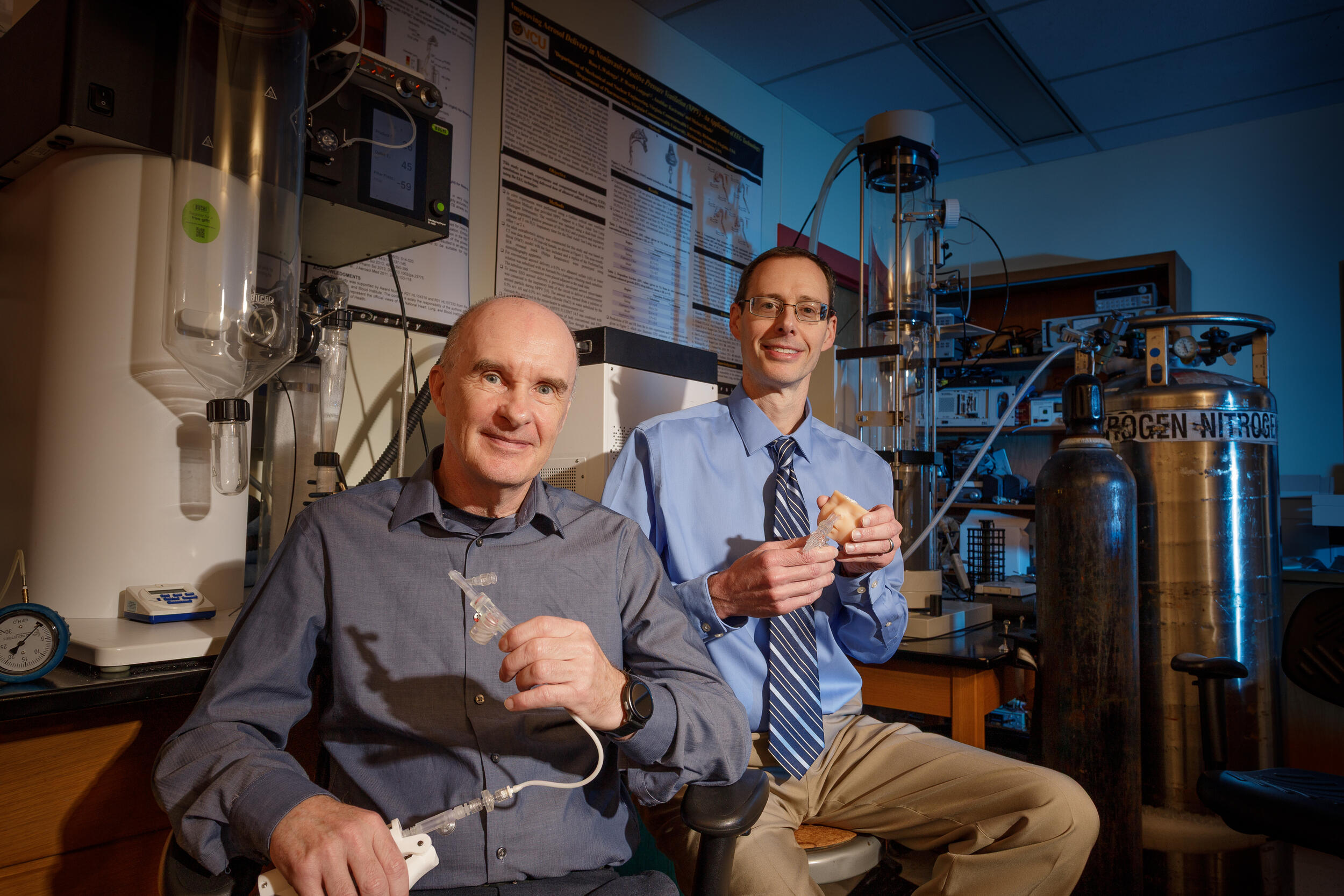
On Nov. 18, two of the research group’s leaders – the School of Pharmacy’s Michael Hindle, Ph.D., and the College of Engineering’s P. Worth Longest, Ph.D. – were honored as the 2025 Billy R. Martin VCU Innovators of the Year by the Office of the Vice President for Research and Innovation and its VCU TechTransfer and Ventures office.
Hindle and Longest were specifically cited for their pioneering aerosol drug delivery systems that could save the lives of premature infants struggling to breathe at birth.
“We stand on the shoulders of those who came before us,” said Hindle, interim chair in the Department of Pharmaceutics and the Peter R. Byron Distinguished Professor – a professorship named after the research group’s founder, who retired in 2016. “This award reflects 40 years of innovation at VCU and the collaborative environment that allows us to take ideas from concept to clinic.”
Hindle and Longest have collaborated since Longest arrived at VCU in 2004. Their research centers on a dry powder aerosol “surfactant” that could offer a noninvasive alternative to mechanical ventilation for preterm infants suffering from neonatal respiratory distress syndrome. In healthy lungs, pulmonary surfactant is a mixture of fats and proteins that coat the inside of tiny air sacs where oxygen exchange occurs. It prevents these sacs (alveoli) from collapsing when inhaling and exhaling. Premature babies often do not have enough surfactant, leading respiratory distress.
“This therapy has the potential to improve survival rates and long-term lung health for the most vulnerable newborns,” said Longest, the Alice T. and William H. Goodwin Jr. Endowed Professor in the Department of Mechanical and Nuclear Engineering. “By eliminating the need for intubation and liquid surfactant instillation, we’re making treatment safer, more accessible and more effective — especially in low- and middle-income countries where ventilators and access to refrigerated storage systems are scarce.”
In addition to VCU, Hindle and Longest’s work has been funded by the National Institutes of Health, the U.S. Food and Drug Administration and, notably, the Gates Foundation. The global nonprofit that fights poverty, disease and inequity provided the VCU team with a $3.2 million grant to develop scalable, affordable formulations and inhalers for use worldwide. Now in its third year, the Gates partnership has connected the team to manufacturing and commercialization partners in Europe and Asia.
While their neonatal work has drawn global attention, Longest and Hindle’s innovations extend beyond pediatrics.
Through NIH funding, they are also developing aerosol therapies for adults with acute respiratory distress syndrome, a life-threatening condition highlighted during the COVID-19 pandemic. Additional funding from the FDA supports new inhaler testing methods, 3D-printed airway models and open-source computational tools that allow pharmaceutical companies to develop generic inhalers more efficiently.
Today, the interdisciplinary team includes engineers, pharmacists and biologists working together across VCU’s campuses. Leaders say it highlights the university’s expansive approach to research.
“Mike and Worth are tremendous examples of what makes our institution so great and so unique. It’s a collaboration among disciplines and across campuses to use our knowledge and our innovation to literally save lives,” said VCU President Michael Rao, Ph.D. “We know that Mike and Worth will be really successful as they move through clinical trials that will help deliver much-needed therapies for babies so that they can breathe.”
For years, the VCU team has been refining aerosolized surfactant delivery using sophisticated 3D-printed airway models and computational fluid dynamics simulations. This year, Hindle and Longest completed their first proof-of-concept study. In April, the team published its findings in the Journal of Aerosol Medicine and Pulmonary Drug Delivery, showing that its hand-actuated dry powder inhaler and surfactant formulation outperformed the current clinical standard in preclinical model testing.
The study marked a major milestone toward clinical trials, critical for FDA approval to get into the hands of physicians.
“We’ve shown for the first time that a premature animal model receiving our surfactant powder recovered in the same way a newborn baby would,” Hindle said. “That’s a huge step forward in proving this can work in real-life conditions.”
Unlike traditional surfactant therapies that require refrigeration, the VCU formulation has proven stable for six months at room temperature with longer studies ongoing, a critical breakthrough for distribution in refrigeration and resource-limited regions like Africa.
“Stability of our powder formulation at room temperature removes one of the biggest barriers to global access,” Hindle said. “Our goal is to ensure that babies everywhere, not just those born in high-income countries, can receive lifesaving treatment.”
Hindle and Longest have had ongoing support from TechTransfer and Ventures, which helps commercialize campus innovations through intellectual property protection and licensing strategy. In fact, one of the first grants they received together in 2008 was from the VCU Technology Validation Fund, a forerunner of the current VCU Commercialization Fund.
“Innovation isn’t just about a breakthrough moment. It requires long, deliberate work to turn research into reality,” said Ivelina Metcheva, Ph.D., assistant vice president for innovation at TechTransfer and Ventures. “Mike and Worth have shown extraordinary commitment to advancing their ideas through every stage: discovery, validation and now translation. They’ve built an ecosystem of collaboration that mirrors what we strive to create across VCU.”
Hindle and Longest credit those partnerships in recent decades for their honor as Innovators of the Year.
“We’ve been very fortunate that we’ve never really had to go outside VCU for many of our collaborations,” Hindle said. “We’re like a small pharmaceutical company, and we are doing everything that a pharmaceutical company would do to develop such a product.”
Added Longest: “This award is a humbling reminder that what we do in the lab ultimately reaches patients … helping them breathe, live and thrive.”
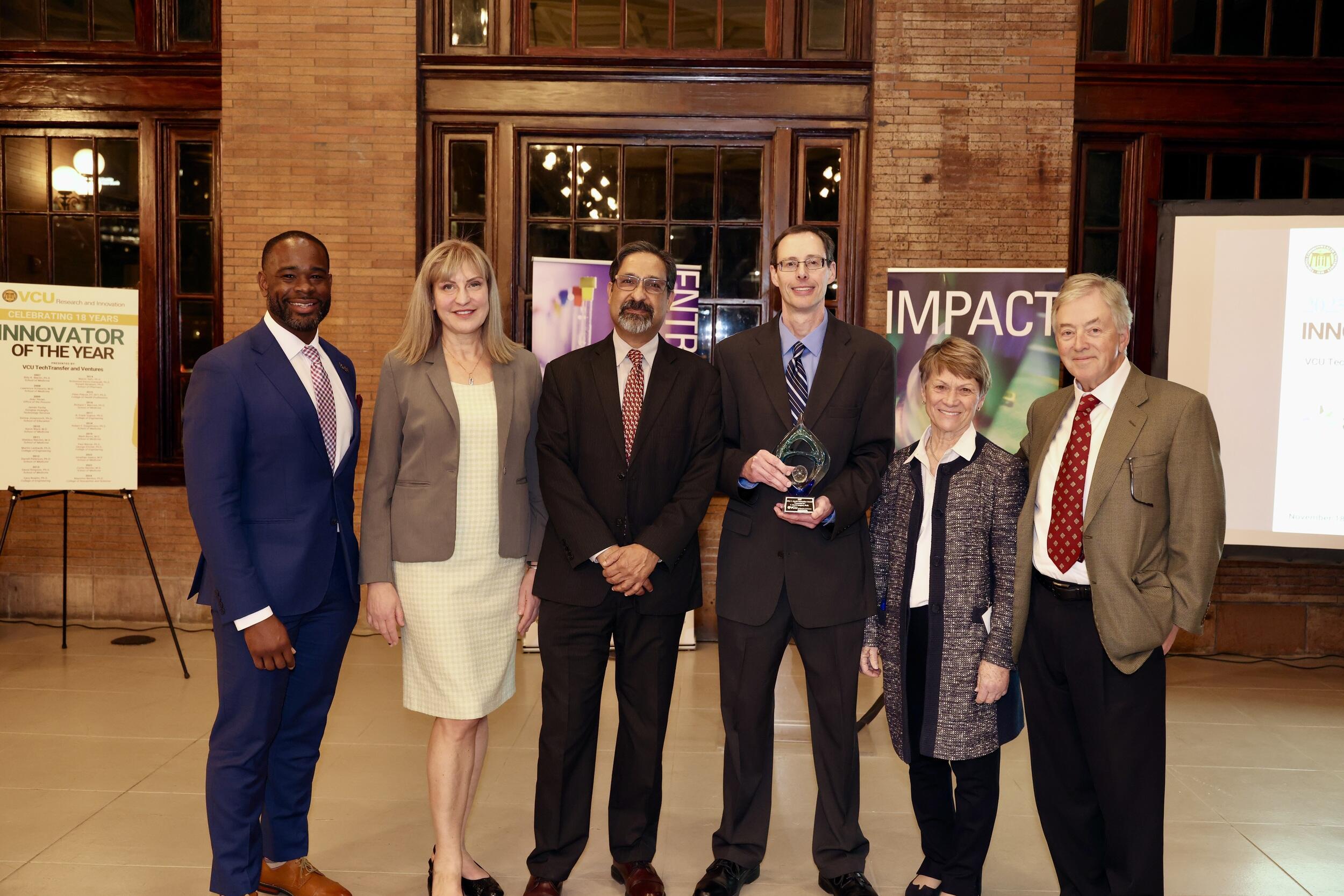
VCU is a top 50 public research institution, and it surpassed $560 million in sponsored research funding in fiscal year 2025 — the seventh consecutive year of record funding and representing a doubling in just seven years. P. Srirama Rao, Ph.D., vice president for research and innovation, said the work of Longest and Hindle represents the spirit and commitment that have powered VCU’s research enterprise.
“By uniting expertise in pharmacy, engineering and medicine, this novel, lifesaving, transdisciplinary research is unsurprisingly attracting interest from many funding organizations,” he said. “Mike and Worth are advancing solutions that can transform care for newborns and adults alike. Their success demonstrates how our faculty’s innovation directly improves lives and fulfills VCU’s mission to serve humanity through research.”
Subscribe to VCU News
Subscribe to VCU News at newsletter.vcu.edu and receive a selection of stories, videos, photos, news clips and event listings in your inbox.