Nov. 24, 2025
Virginia Government Simulation lets students pick up the bills
Share this story
From the second-floor hallway outside the state Capitol’s House of Delegates chamber, the chatter sounded familiar. Voices called out “Point of inquiry,” and white name cards were raised, awaiting acknowledgement by the speaker standing at the front of the room.
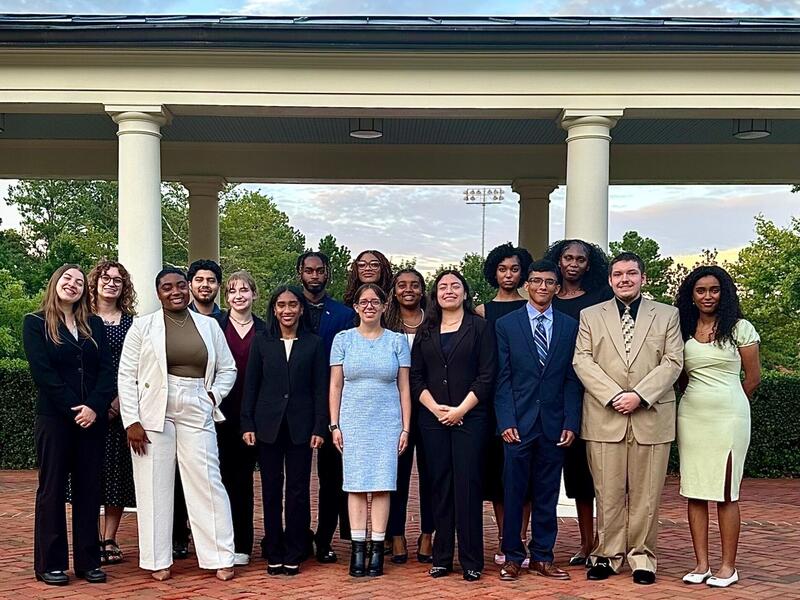
But this wasn’t a typical legislative session: Instead, nearly 100 students from colleges and universities around Virginia were in the halls of power Nov. 12-14 for the Virginia Government Simulation, which lets participants experience life from a lawmaker’s seat – literally.
Presented by Virginia Commonwealth University’s Institute for Democratic Empowerment and Pluralism, part of the Department of Political Science in the College of Humanities and Sciences, the three-day simulation puts students in the role of a state legislator as they research positions, elect party leadership, propose laws and debate legislation. The program debuted last year.
Among bills on this year’s docket was one from fourth-year VCU political science major Patrick Greenwalt, which would create a program to explore how Virginia could connect water utilities infrastructure to disconnected localities.
Greenwalt’s path to political science was inspired by his grandfather, the director of the U.S. Fish and Wildlife Service from 1973 to 1981. Ahead of this month’s student event, he said he hoped his proposal might find its way onto the desk of a real-world legislator who could take it from simulation to reality.
“The real and impactful thing that the simulation can do is we can make our own legislation, and if it passes, what are the odds that you can actually present it to a real legislator to see if they can’t turn it into a real piece of legislation?” Greenwalt said.
“There are a lot of connections to people” in the General Assembly, he said of the program. “I can introduce myself and say, ‘Hey, I was part of the government simulation,’ and [they’ll know] exactly what I’m talking about and what I’ve participated in.”
Over the course of three days, the students, all of whom brought drafted legislation, worked to get their bills through committee meetings and then onto the floor, where the entire body discussed and debated them.
First-year VCU political science major Amaya Shirley wrote and presented a public transportation bill, which provided a framework to introduce fare-free public transportation statewide. She takes the bus to and from the Monroe Park Campus every day, and she wanted to bring impactful legislation to the simulation.
“I’ve always been interested in politics and the way the government works,” said Shirley, who wants to become a lawmaker – and acknowledged some pre-event nerves. “I’m trying to remember all the rules of order, how to present certain pieces of legislation, how to influence the committee and then how to bring that on the floor.”

For Greenwalt, the power of compromise – and conversation – is a major lesson of the simulation, which he also joined in its 2024 debut.
“It requires a large degree of [willingness] to engage and seek a middle ground,” he said. “Nothing’s going to get done” without such open-mindedness. “You have to be flexible.”
In the view of Amanda Wintersieck, Ph.D., director of the Institute for Democratic Empowerment and Pluralism and associate professor in the Department of Political Science, the simulation is “a depolarization project – an attempt to bring students from diverse backgrounds, institutions and disciplines together to confront questions about our democracy and to practice solving real-world policy problems facing our commonwealth.”
She added, “My hope is that students leave the experience with a better understanding of how state government works, a stronger sense of their own political voice and power and the confidence to work across differences in the pursuit of strengthening our democracy.”
By the end of the simulation, Greenwalt’s water infrastructure bill made it through committee meetings and onto the floor, where it passed and was ultimately signed by the simulation’s governor. Greenwalt, who was named a “Future Delegate” for his efforts, hopes more students participate as the event grows.
“Get involved,” he said. “This program really pushes students to progress. And once you start this program, there’s no not doing it again. Everyone in the simulation said that they’re coming back.”
Subscribe to VCU News
Subscribe to VCU News at newsletter.vcu.edu and receive a selection of stories, videos, photos, news clips and event listings in your inbox.