Oct. 22, 2025
TV icons have creatively joined a new Robertson School course
Share this story
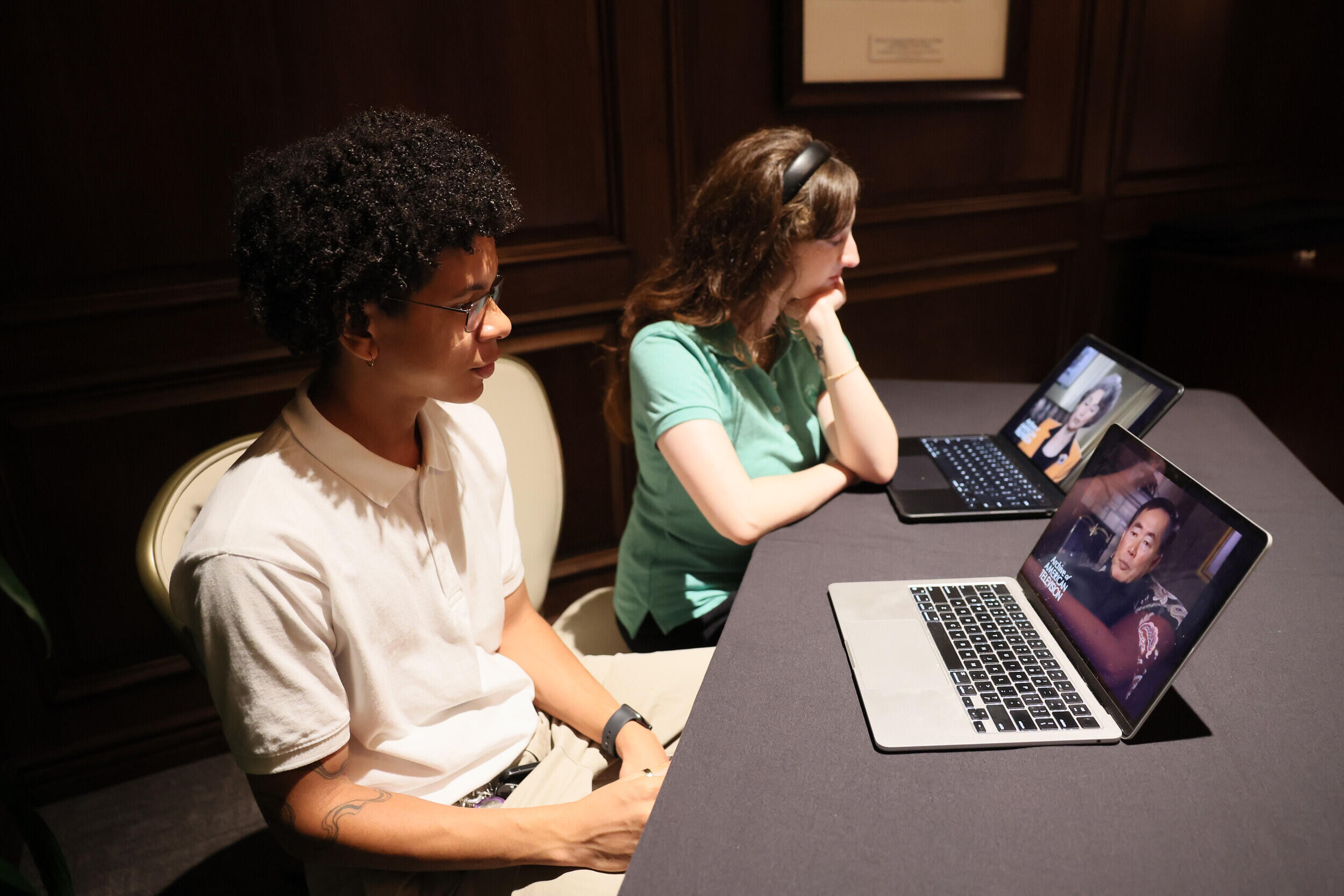
A new course covering the multifaceted world of television is giving Virginia Commonwealth University students the opportunity to learn from Hollywood’s greatest minds – through archival video, that is.
The curriculum shapes its lessons using more than 100 clips from a vast archive, compiled by the Television Academy Foundation, that explores 70 years of TV history and its wide-ranging impact on everything from politics to culture.
Joshua J. Smith, Ph.D., an assistant professor in VCU’s Richard T. Robertson School of Communication and special assistant for innovative learning and AI initiatives in the College of Humanities and Sciences, worked with the foundation to build the curriculum. The idea originated through a conversation with Robertson School namesake Dick Robertson, who in 2023 pitched Smith on the concept of taking the thousands of publicly available interviews in the foundation’s collection to incorporate into a 16-week course.
Building the course took a lot of hours – and a lot of interviews.
“We wanted to make sure that the content that [students] were getting was equivalent to sitting down and reading a chapter” in a textbook, Smith. “It involved curating the right clips, going through and making sure that they were appropriate, and then moving forward, finding supplements and extra materials.”
Among examples in the curriculum, esteemed CBS News anchor Walter Cronkite discusses the “great story of our century” – man landing on the moon – while actor and “Reading Rainbow” host LeVar Burton addresses the positive evolution of representation on TV and journalist Connie Chung recalls her coverage in the aftermath of 9/11.
Robertson, a VCU alum and longtime television executive who helped lead the creation of the archive, pointed to its unique offerings as an educational tool.
“If you were a young person today thinking about entering the television industry, [wouldn’t it] be great to watch some of these interviews so you could figure out where your interest would be – in front of or behind the camera or on the business side of it – and see how these people did it way back when and even now?” he said.
The interviews are filmed in a documentary-style and range in length from one to several hours. They were created as part of an archival effort that launched in 1997 as the Archive of American Television before it was renamed to The Interviews: An Oral History of Television in 2017. Interviewees includes actors, stunt doubles, television hosts, producers, directors, makeup artists and more, capturing viewpoints from across the industry.
“There’s nothing like hearing stories directly from those who had a hand in history, and the foundation’s interviews bring to life a rich history that should remain top of mind as the industry evolves,” said Anne Vasquez, chair of the Television Academy Foundation. “Students are savvy and have more information available at their fingertips than ever before – there’s so much inspiring content in these videos, just waiting for students to discover.”
The VCU course – MASC 291: Oral History of TV – which is being taught this semester by adjunct professor Andrew Massa, Ph.D., uses 122 clips in total, spread out over 16 weeks.
“There’s definitely traction and momentum [as well as] a desire by students to have a multimedia learning experience that goes beyond the textbook,” said Smith, who also is founder of VCU’s Media + AI Initiative. “I’m not dismissing textbooks – they still have a place. But what [the archive] gave me was an opportunity to pull from a vetted list of [free] resources … where students could watch and listen, rather than just read.”
Smith had piloted an early version of the curriculum during the TV unit in his MASC 101 course. The feedback from students pushed him to reach out to the Television Academy Foundation to explore the creation of a full course.
Vasquez said the foundation is eager to work with four-year institutions and community colleges to offer the curriculum.
“The foundation has devoted close to three decades capturing first-person accounts of the industry’s most influential creators and leaders,” she said. “We have always encouraged educators to tap into the collection for their media classes and were thrilled when Dick Robertson – an early champion of the power of these oral histories – worked with VCU and Dr. Smith formally to develop a curriculum out of our video-based oral history archives.”
Smith hopes the program can serve as a model for multimedia teaching in any subject.
“We want to make it fun and interesting – that’s the point,” he said. “With this [course] being cross-listed across the humanities, we’re pulling in students from everywhere. And who knows what a class like this might inspire later on? But I’ve taught long enough, and I’ve been a student long enough, to know that the engagement in a class is a currency.”
Subscribe to VCU News
Subscribe to VCU News at newsletter.vcu.edu and receive a selection of stories, videos, photos, news clips and event listings in your inbox.