May 22, 2026
Hit by a cyclist, VCU professor has a 3D brainstorm
Share this story
High-tech anthropologist Bernard K. Means’ research has spanned everything from the last Genuine Smithfield Ham and the Connecticut vampire to Ice Age megafauna. But, after a recent incident sent him to the ER, the Virginia Commonwealth University professor’s efforts took a more personal turn.
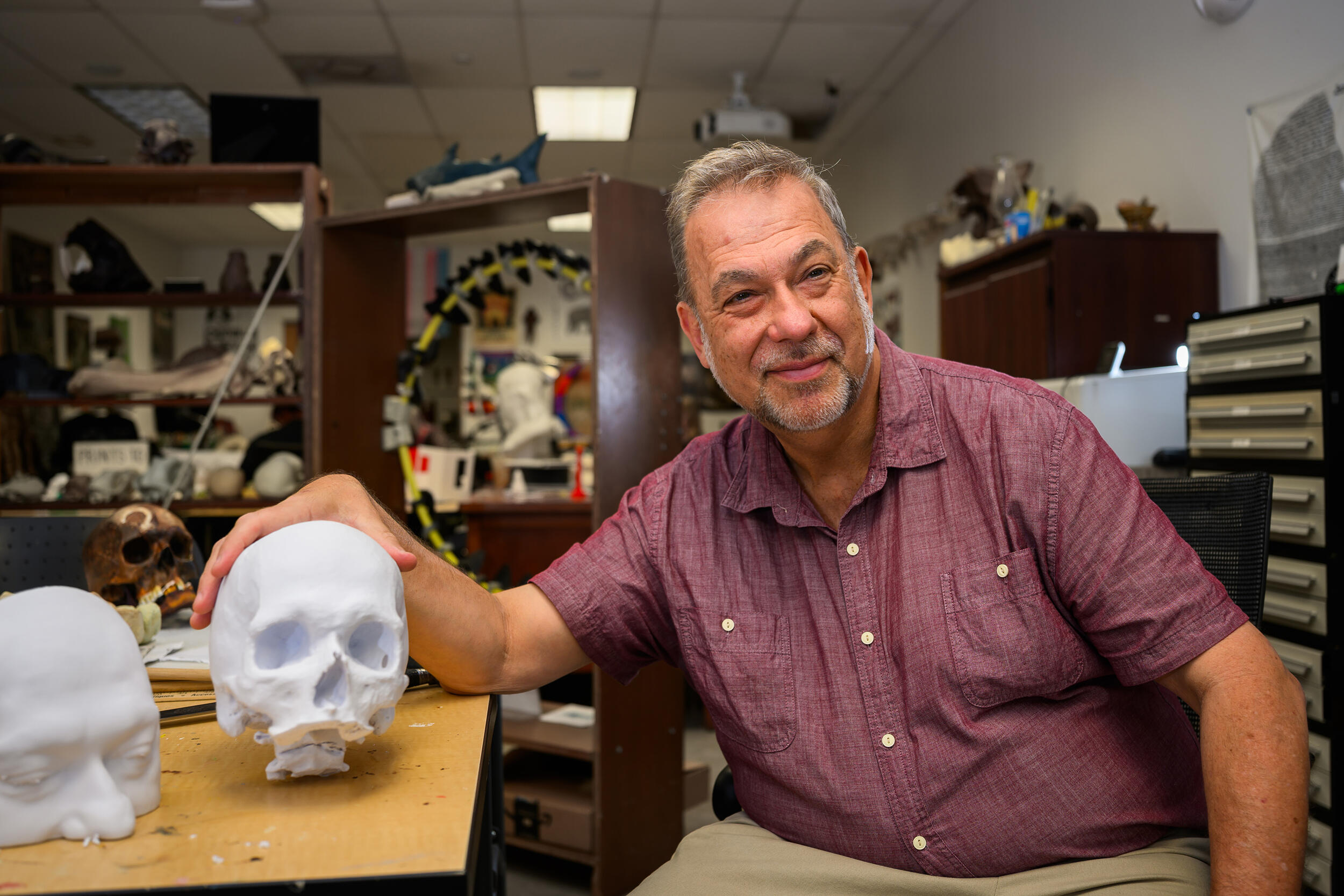
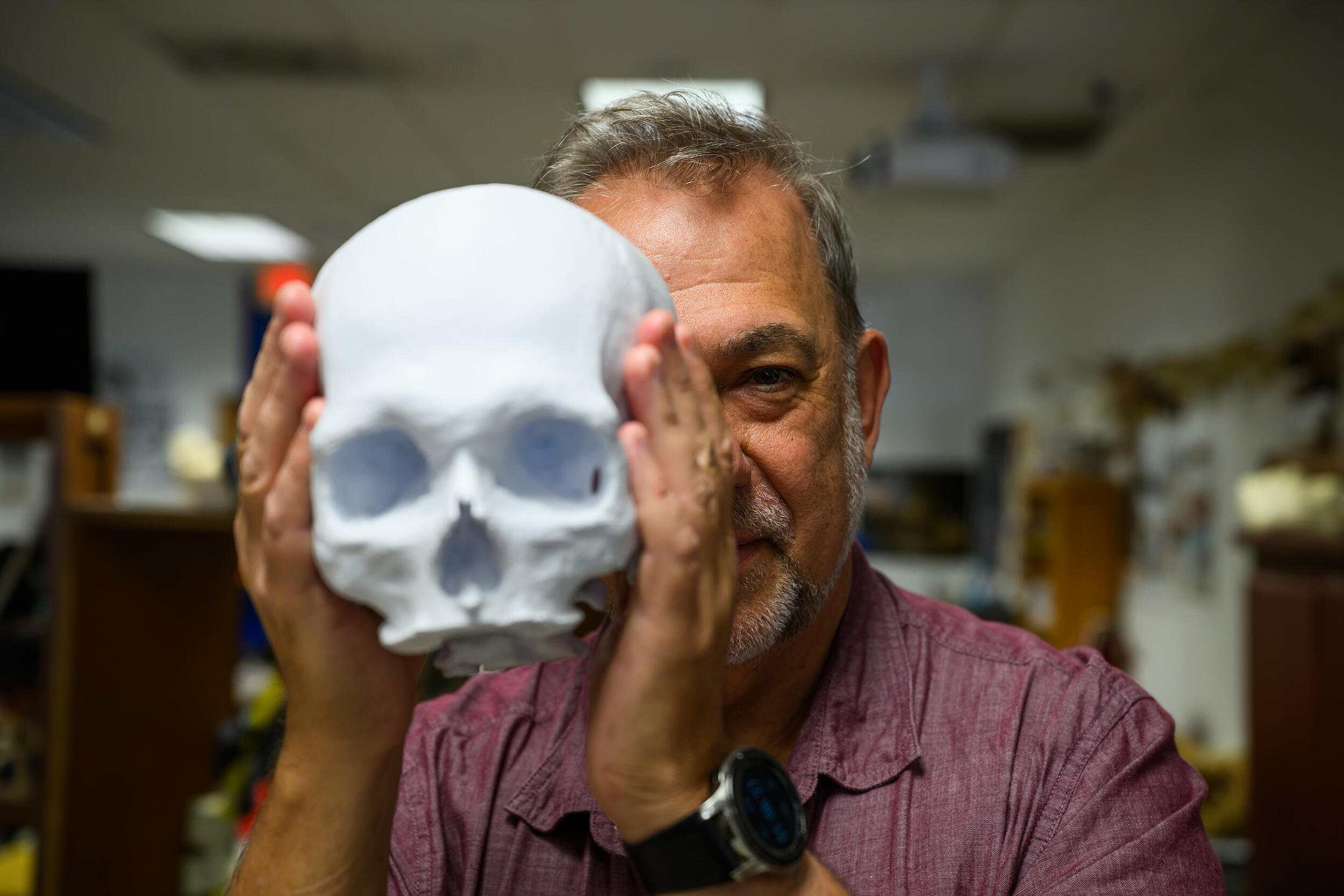
His latest project? 3D-printing his own skull.
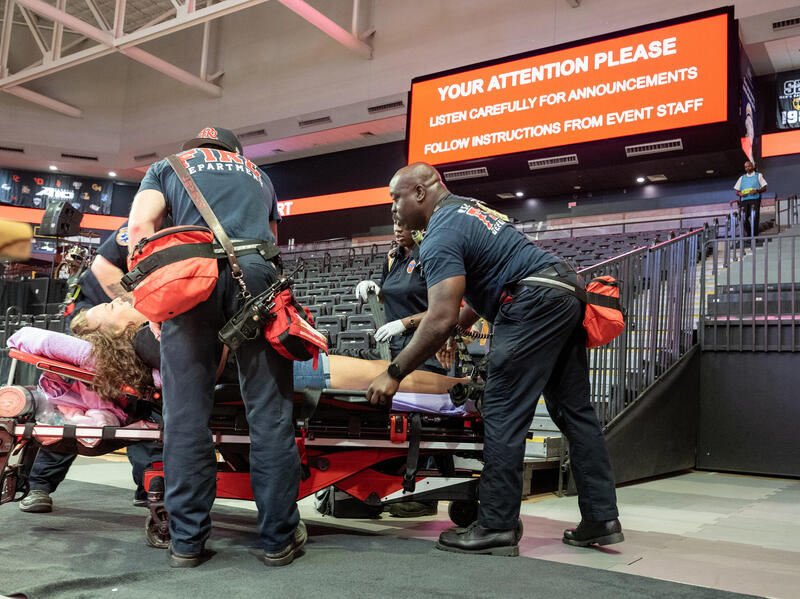
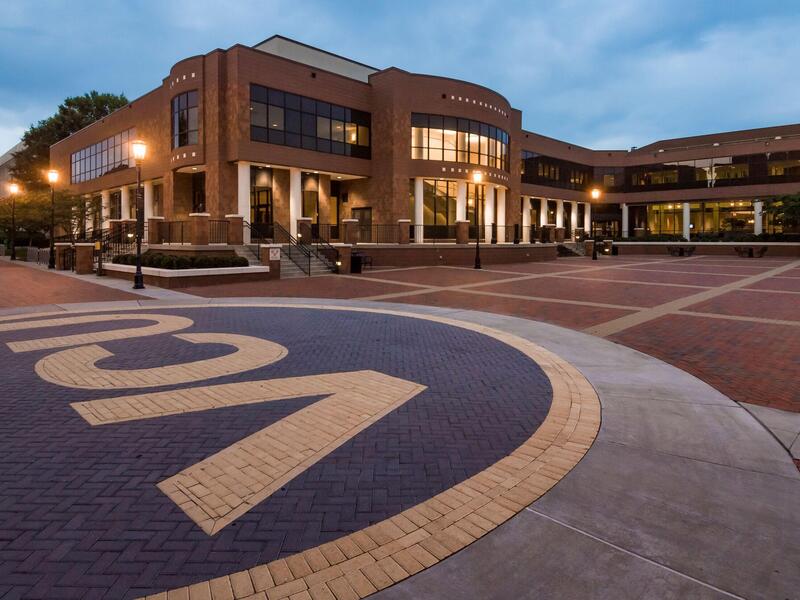
In the spring semester, Means, Ph.D., was in a crosswalk on the Monroe Park Campus when he was struck by a cyclist who ran a red light. Means was taken by ambulance to VCU Health, where he received a CT scan – and, thankfully, a (relatively) clean bill of health.
Though he sported some new bumps and bruises – and a golf-ball-sized hematoma sticking out of his forehead – Means was thinking of a bigger picture: “While I was in the emergency room, I asked them, ‘How do I get the CT data?’”
For the director of VCU’s Virtual Curation Lab, which creates 3D digital models of historical, archaeological and paleontological objects, if life presents you with images of your recently scanned skull, you make a full-size, real-life rendering.
Means, an associate professor in the School of World Studies, part of the College of Humanities and Sciences, had wanted to do a similar project since he was a kid: He was hit by a car and fractured his skull, spending about two months in the hospital. The incident left him with a permanent mark, one that can be seen in his new 3D model: The back of his skull is slightly lopsided, one side having grown larger than the other.
“When you feel it, it doesn’t feel that evident, but I could tell every time I put on a baseball cap,” Means said, demonstrating a hat sitting askew on his head.
Virtual Curation Lab manager Nasrin Alizada, a senior anthropology major, has worked with plenty of bones and fossils. But this was the first time she could speak directly to the subject.
“In anthropology, there are a lot of ethical considerations around working with human remains,” said Alizada, who was with Means when he was struck last semester and rode with him in the ambulance. But “since you have the actual skull owner [here], you’re not worried about how the skull was acquired.”
To turn his new CT scan into a printable model, Means turned to frequent collaborator and former VCU colleague Terrie Simmons-Ehrhardt, whose company, OsteoRenderings, provides virtual and 3D-printed resources for educational purposes.
Simmons-Ehrhardt began 3D-modeling CT scans as an ORISE fellow at the FBI Counterterrorism and Forensic Science Research Unit, where she worked on a 3D facial approximation project. From there, she went on to learn 3D scanning, printing, digital sculpting and animation as they apply to osteology.
For a project like Means’, Simmons-Ehrhardt takes the 2D grayscale slices that comprise a CT scan. She then uses software to extract the voxels – the 3D version of a pixel – and convert them to a 3D model. To get a clean model, some manual editing is involved, filling in areas where the bone is less dense (and therefore less bright).
“This requires expertise in osteology, and especially seeing it in cross-sectional views,” Simmons-Erhardt said.
In addition to the solid skull model she has provided to Means, Simmons-Erhardt also plans to make another with the internal skull data “so Bernard can slice his skull open and look inside.”
With his new skull model – already the star of many social media posts and a conversation piece at a recent conference in San Francisco – Means sees a new world of possibilities: a Halloween mask, maybe, or having someone do a facial reconstruction based off of the skull without any other details. A poster symposium. A comic recreating the collision with the cyclist. There are even 3D printers that print shapes in chocolate (though that’s not quite in the budget yet).
“The advantage to having my own skull – beyond it being a personal kind of thing – is that I can use it in ways that I wouldn’t otherwise use [someone else’s],” Means said.
While Means has found a silver lining in his incident, VCU Police continue to emphasize the safety of everyone on the road with Operation Safer Streets, a targeted traffic enforcement operation launched in January. The first phase resulted in 1,943 traffic stops and 1,760 summonses issued, and data from the operation will help inform safety efforts around campus. VCU provides an updated list of pedestrian safety projects at this information page.
Subscribe to VCU News
Subscribe to VCU News at newsletter.vcu.edu and receive a selection of stories, videos, photos, news clips and event listings in your inbox.