Feb. 27, 2026
National Academy of Inventors honors five VCU College of Engineering researchers
Share this story
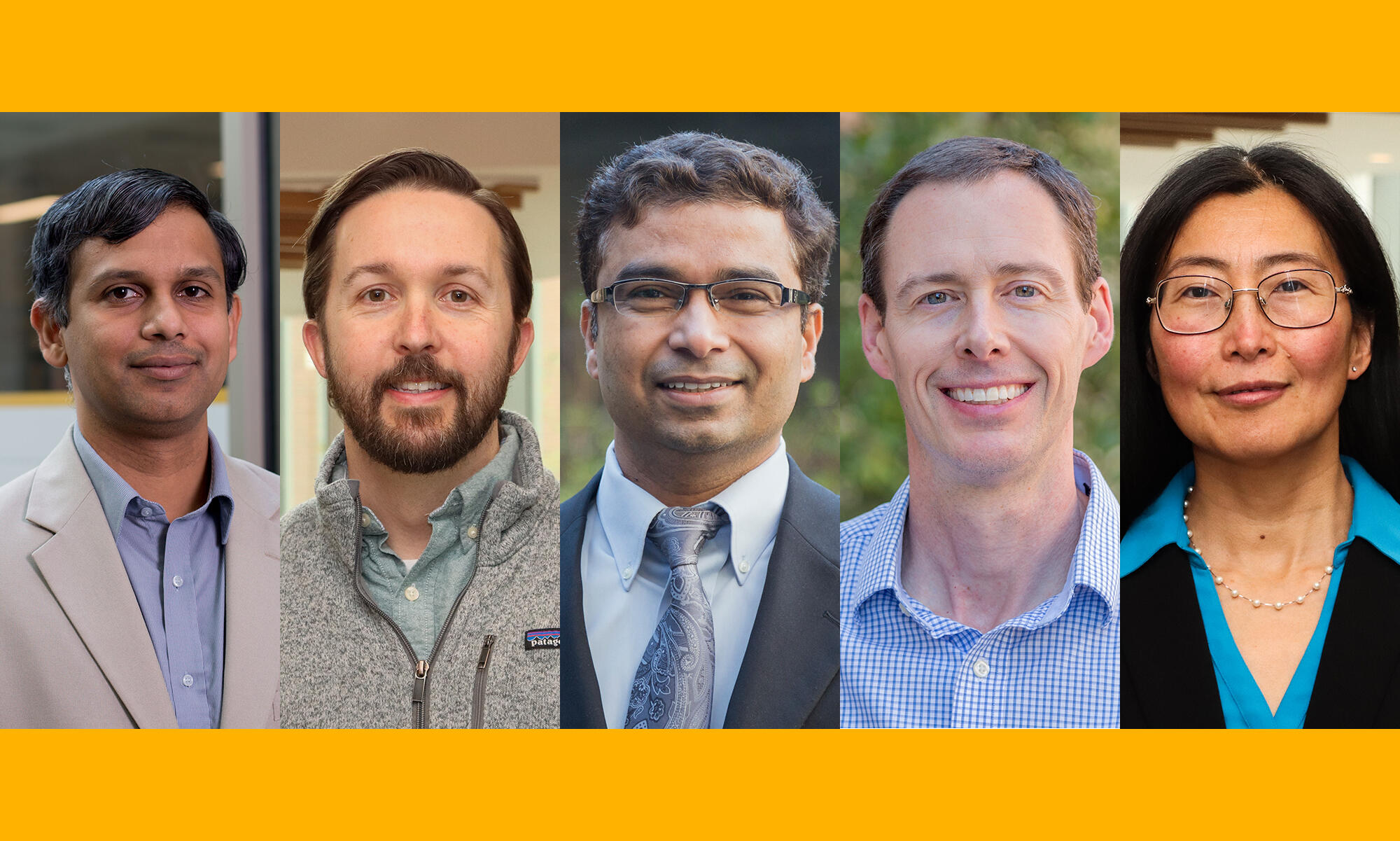
Five researchers from Virginia Commonwealth University’s College of Engineering have been selected for the National Academy of Inventors’ new class of senior members. Chosen for their engineering innovations, the 2026 honorees are recognized for groundbreaking research and patented technologies that are driving societal and economic advancements.
“Invention represents the practical application of knowledge and stands as one of the many ways engineers can make a positive impact on their communities and the world,” said Azim Eskandarian, D.Sc, the Alice T. and William H. Goodwin Jr. Dean of the College of Engineering. “This year’s honorees exemplify the interdisciplinary nature of our field, leveraging advanced concepts from mechanical, biomedical, chemical and pharmaceutical engineering to address today’s most pressing challenges.”
Here are the College of Engineering’s new NAI senior members, all of them based in the Department of Mechanical & Nuclear Engineering:
Jayasimha Atulasimha, Ph.D.
Engineering Foundation Professor
A pioneer of straintronics, an approach to electrically control magnetism for ultra-low-energy computing, Atulasimha has made significant research contributions to next-generation memory, neuromorphic hardware and emerging quantum computing technologies. He holds four U.S. patents spanning energy-efficient magnetic memory, nanoscale computing architectures and medical tools.
Atulasimha’s commercially viable inventions are funded by organizations including the Virginia Innovation Partnership Corp., and he leads multi-institutional collaborations that drive innovation in computing hardware, artificial intelligence and quantum technologies, with more than $10 million in funded research.
Casey Grey, Ph.D.
Postdoctoral research associate
Bridging engineering and medicine, Grey’s work spans lifesaving stroke technologies, breakthrough respiratory and neurological care, and sustainable packaging.
In medical device innovation, Grey’s patent and development work on a novel cyclic aspiration thrombectomy platform, currently in clinical trials, is advancing stroke treatment by enhancing clot removal efficiency and reducing long‑term disability. As a lead R&D scientist at WestRock, he helped create and commercialize the CanCollar® portfolio, a recyclable paperboard replacement for plastic beverage rings now used on five continents, eliminating thousands of tons of single‑use plastic annually.
At the VCU College of Engineering, Grey built a research and commercialization pipeline around neurological and respiratory technologies, securing eight provisional patents and leading multidisciplinary teams in neurology, neurosurgery, surgery, pharmacology and toxicology, internal medicine and respiratory medicine.
His work includes developing dry powder inhaler strategies for patients with acute respiratory distress syndrome, a pediatric bubble CPAP system to protect brain development in premature infants, and noninvasive neuromodulation therapies to treat neurodegeneration and conditions with significant central nervous system complications, including sickle cell disease. In collaborations with VCU hospitals, Grey is leading two clinical studies that are translating these innovations to improve pediatric and adult patient care.
Ravi Hadimani, Ph.D.
Associate professor and Biomagnetics Laboratory director
Hadimani founded RAM Phantoms LLC, a VCU startup that is commercializing anatomically accurate, MRI-derived brain phantoms for neuromodulation and neuroimaging applications. These brain phantoms help test and tune transcranial magnetic and deep brain stimulation technologies, improving clinical safety and enabling personalized therapy for patients.
Beyond commercialization, Hadimani maintains a research program with more than $4.5 million in funding, resulting in 125 original peer-reviewed publications, 17 current and pending patents, a book, and several book chapters. His biomagnetics lab serves as a training ground for undergraduate, graduate and Ph.D. students to hone their skills in innovation management, intellectual property strategy and startup development.
Before joining VCU, Hadimani led the development of hybrid piezoelectric–photovoltaic materials that established FiberLec Inc., which commercialized multifunctional energy-harvesting fibers capable of converting solar, wind and vibrational energy into usable electricity.
Worth Longest, Ph.D.
Alice T. and William H. Goodwin Jr. Distinguished Chair
Uniting aerosol science, biomedical engineering and computational modeling, Longest is revolutionizing inhaled-drug delivery. Working with collaborators, his lab has developed novel devices, formulations and delivery platforms that precisely target medications to the lungs, addressing conditions like cystic fibrosis, pneumonia, acute respiratory distress syndrome and neonatal respiratory distress syndrome.
These innovations have resulted in multiple patents. Some have been licensed through commercial partnerships like Quench Medical, an organization advancing inhaled therapies for applications including lung cancer.
Collaborating with the Gates Foundation and the lab of Michael Hindle, Ph.D., from the VCU Department of Pharmaceutics, Longest’s team developed a low-cost, high-efficacy aerosol surfactant therapy for pre-term infants based entirely on technology developed at VCU. The invention eliminates intubation, reduces dosage by a factor of 10 and cuts treatment costs. Over 9 million infant lives are projected to be saved by this technology between 2030 and 2050.
Through a long-term collaboration with the Food and Drug Administration, Longest’s in vitro and computational methods provide federal regulatory guidance for generic inhaled medications. The VCU mouth-throat airway models developed under his leadership are used globally across the pharmaceutical industry and in government laboratories.
Hong Zhao, Ph.D.
Associate professor
Zhao holds 40 patents with innovations spanning additive manufacturing, stretchable electronics, inkjet printing technologies and superoleophobic materials that repel oils, greases and low-surface-tension liquids. Her research has applications across health care, sustainable energy and advanced manufacturing.
Prior to joining the College of Engineering, Zhao served as a senior research scientist and project leader at the Xerox Research Center, where she developed high-performance materials and printing technologies for commercial deployment. Zhao is an invited reviewer for more than 50 premier journals and grant agencies.
“Working with distinguished researchers and innovators like those inducted into the National Academy of Inventors is a great honor for me,” said Arvind Agarwal, Ph.D., chair of the Department of Mechanical & Nuclear Engineering and an NAI fellow. “They are an inspiration and showcase the kind of impact engineers can make. Having all five of these innovators as part of our department amplifies the scientific richness of our college and its societal impact. They advance the college’s mission of Engineering for Humanity, with research that brings a positive change to our world.”
The 2026 NAI class of senior members, composed of 231 emerging inventors from NAI’s member institutions, is the largest to date. Hailing from 82 NAI member institutions across the globe, they hold over 2,000 U.S. patents. They will be honored at the NAI’s 15th annual conference this June in Los Angeles.
Subscribe to VCU News
Subscribe to VCU News at newsletter.vcu.edu and receive a selection of stories, videos, photos, news clips and event listings in your inbox.