Jan. 22, 2026
VCU helps make the Ethics Bowl a philosophy spotlight for high school students
Share this story
It doesn’t quite have the hype of the Super Bowl – and there’s no halftime show, either. But for young, philosophy-minded scholars, the annual Virginia High School Ethics Bowl is a prime-time affair.
The competition – hosted by Collegiate School in collaboration with Virginia Commonwealth University’s Department of Philosophy, part of the College of Humanities and Sciences – brings together high school teams from around the state each December to wrestle with real-world dilemmas and practice civil discourse.
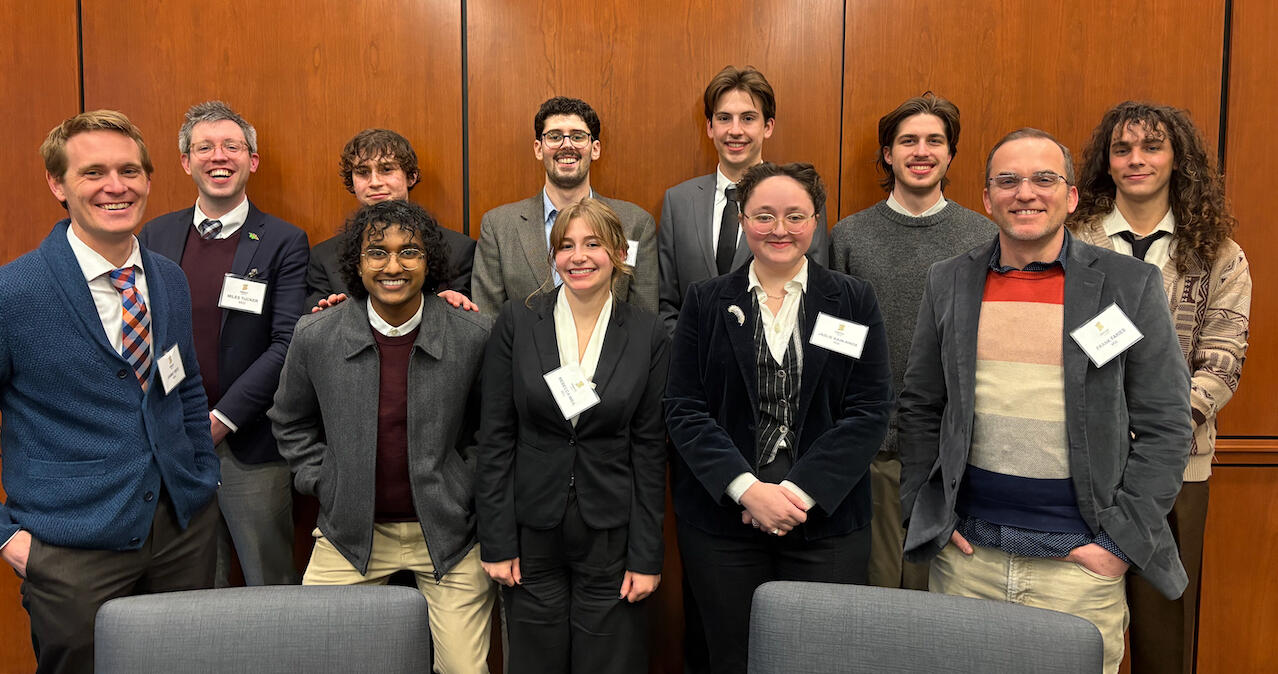
The daylong event draws a dedicated crowd of families, friends and students. And every year, VCU is well-represented. Since 2015, faculty, students and alums from the Department of Philosophy have come together to provide support for the competition.
Between judging, moderating and spectating, it’s a full day. And assistant professor of philosophy Miles Tucker wouldn’t have it any other way.
“It’s something that the department finds very valuable,” said Tucker, Ph.D. “It’s integrated with our values of open, reasonable discourse, and it’s wonderful to see high school students doing ethics.”
Rachel Zahradka, who graduated last spring with dual degrees in philosophy and African American studies, still remembers her first Ethics Bowl experience, which included listening to one team make an argument with which she fundamentally disagreed.
“But I had to turn my philosophy brain on,” she said. “Like, ‘What’s their reasoning? How are they doing this?’ And that’s one of my favorite things about philosophy – that we can do those things and high school students can play with that in a safe space. Some of these cases can get really controversial, and these students get to handle these really big topics.”
At the most recent Ethics Bowl in December, those big topics ranged from a proposed bill allowing incarcerated individuals to donate organs or bone marrow in exchange for sentence reductions, to the use of an AI-generated “deepfake” of a murder victim delivering an impact statement in court.
As the director of JK-12 capstones at Collegiate, Rhiannon Boyd coordinates the Ethics Bowl every year. Participating in such discussions, she said, “is where students move from what is to what … could be, and perhaps should be.”
The event offers opportunities to practice “listening for understanding, allowing ourselves to be vulnerable in sharing our thoughts with others and to be questioned about our values and ideas,” Boyd said, as well as “offering ideas for others to consider that may help to elevate their thinking.”
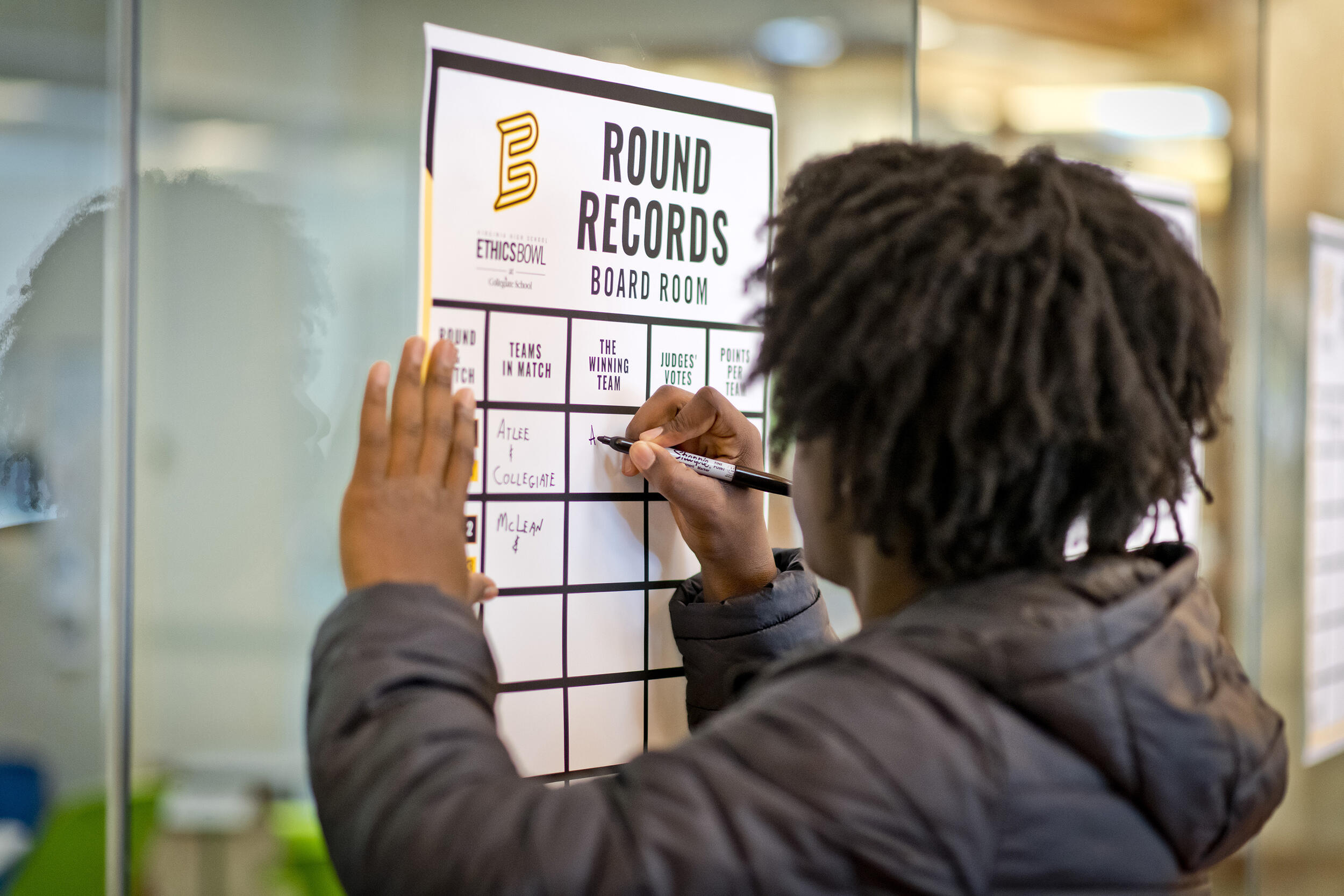
Each round of the Ethics Bowl involves two teams and two cases, with the teams being scored on their ability to analyze their assigned cases and how well they develop their position. For each round, three judges and a moderator evaluate teams on their ability to engage in civil, productive dialogue and answer tough questions from the judges.
The event’s top team advances to a virtual playoff to compete for a spot at the National High School Ethics Bowl, organized by the Parr Center for Ethics at the University of North Carolina at Chapel Hill.
For the VCU philosophy students who participate, the Ethics Bowl can be an experience that many wish they had in high school. Tucker called philosophy a “found major” – meaning that a large number of its students were already enrolled in college by the time they figured out they wanted to pursue the discipline.
Sky Evans, a senior philosophy major and chemistry minor on a pre-medical track, came to VCU with the intention of studying psychiatry. But in spring semester of freshman year, he took the Introduction to Ethics course with Tucker, which “set me on a path that I didn’t know was available to me,” he said.
“After taking that class, [I realized], ‘Wow, there’s so much more to academic philosophy than just arguing and debating and being right,’ which is kind of what my perspective was before I came to VCU,” Evans said. “Finding out that wasn’t the case – and that it’s a much richer, involved thing – was wonderful, and every single class I have taken in philosophy has been compounding on itself in how important it’s been to me mentally and academically.”
The Ethics Bowl also strengthens ties within and beyond VCU.
Before the most recent competition, Zahradka said she was looking forward to making her first appearance as an alum: “I was really hoping that there was something that would keep me still tied – even just once a year – to the Philosophy Department and the people that I love there. … It just feels very lovely, and I still feel connected.”
And for Collegiate, the partnership with the VCU department has been a boon, Boyd said.
“They clearly believe in the capacity of young people to think at a high level, and they’re exquisitely skilled in asking questions that push their thinking while not encouraging it to feel like sport for its own sake,” she said. “There’s a sense that we’re talking about things that matter, and that these experts in their fields are genuinely interested in what these young people have to say.”
For Tucker, giving high-schoolers such a platform makes the Ethics Bowl a winner in its own right.
“Even if no one’s going to pursue philosophy as a result of this – which I don’t think is true – people often do get a kind of spark,” he said. “To me, what’s most important is just the critical thinking and the ability to talk to each other – the idea that this is possible, the idea that discourse is possible, that reason is possible and that finding solutions together is possible.”
Subscribe to VCU News
Subscribe to VCU News at newsletter.vcu.edu and receive a selection of stories, videos, photos, news clips and event listings in your inbox.