June 3, 2026
VCU researchers advance quantum computing with tiny, virus-sized nanomagnets
Share this story
Quantum computing, once only a theoretical possibility, promises to deliver faster, more energy-efficient computers – but only if scientists can build and scale the hardware needed to run the machines. New research from Virginia Commonwealth University brings scientists one small step closer to quantum computing at a practical scale, which could help dramatically reduce energy usage and computing times in some industries.
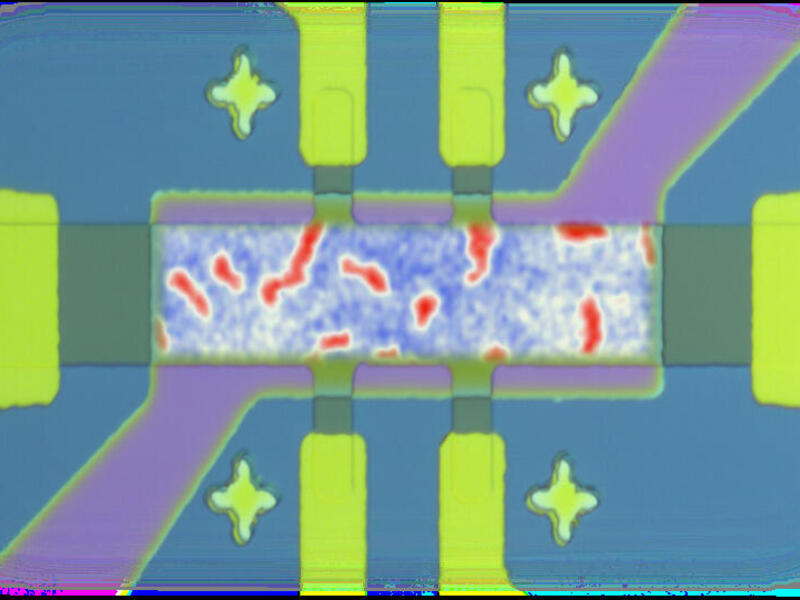
In the study, recently published in Nature Communications, the researchers used minuscule magnets – twice as small as the wavelength of light – to create the building blocks of quantum computing, pioneering a technique that could decrease the physical space needed to create a viable quantum computer.
“This work has the potential to advance quantum computing,” said Jayasimha Atulasimha, Ph.D., a professor of mechanical and nuclear engineering in VCU’s College of Engineering and the study’s principal investigator. “We’re solving a specific problem for spin-based quantum computing, which has the potential for scaling.”
Quantum building blocks
The computer or smartphone displaying this article uses basic electronic devices called transistors to crunch numbers and make internet searches. Transistors turn electric signals on or off, which is how computers make calculations.
In quantum computing, the equivalent to that on or off signal – also called a bit – is the quantum bit, or qubit. In the Atulasimha lab, each qubit starts with a millimeter-sized diamond, with a tip that tapers down to only a few atoms across.
Those diamonds are made up of a lattice of carbon atoms, which form strong bonds with each other. Atulasimha and other quantum engineers use lab-grown diamonds with tips that are intentionally missing two side-by-side carbon atoms in their structure. One of those spaces is filled by a nitrogen atom, but the other is left empty.
That leaves free electrons within the diamond – and those loose electrons create the backbone of the qubit. Electrons act like tiny magnets, and the aim of quantum computing is to control and measure the strength and direction of the magnetic field – a factor also known as the “spin” – that those unpaired electrons generate.
By making the electrons’ spins point up or down, equivalent to conventional computers’ “on” and “off” switches, quantum computers could perform calculations that today’s computers cannot.
“It’s a powerful way of solving a lot of problems in chemistry, in cryptography – specific problems could be sped up enormously,” Atulasimha said. “We are trying to work on the hardware that enables this to happen.”
A new spin on quantum computing
Previous research has typically used an electromagnetic signal from a wire antenna to control the spin of the free electrons within the diamond’s tip. But the signal from those antennas covers a wide area, making it difficult to control the spins of electrons from several diamonds individually within a multi-qubit computer chip. That makes it impractical to create a functioning computer, as the qubits, also called spin qubits, need to be spaced far apart.
“With one quantum bit, we cannot make useful computations,” said Fahim F. Chowdhury, a Ph.D. candidate in the Atulasimha lab and the study’s first author. “We need thousands of these, and they have to be very close together.”
That’s where the lab’s tiny magnets step in. Most of these nanomagnets measure about 200 nanometers across – 500 times thinner than a sheet of paper, and approximately the length of the microscopic virus that causes chickenpox.
In their recent study, the researchers paired a nanomagnet with a diamond qubit to find out if they could control the spins of the qubit’s free electrons. The answer was yes: By using acoustic waves to control the nanomagnet, they were able to alter the quantum state of the electrons.
“We are making a unique control mechanism. These qubits store information for a long time and can operate at high temperatures,” Chowdhury said. “But scalable implementation with many qubits on a single chip remains a key challenge.”
Tiny magnets, big applications
The lab’s new magnet-driven technique is potentially more energy-efficient, better at storing information and more scalable compared with other quantum computing approaches, which could translate to greater energy savings down the line.
“As the world demands more computing power, the work that Dr. Atulasimha and his team are doing will only grow in importance,” said Srirama Rao, Ph.D., vice president for research and innovation at VCU. “Research like this has potentially critical ramifications for our future, and it’s emblematic of the kind of work being done at VCU to tackle the most sophisticated and pressing challenges we face.”
The lab’s nanomagnets could also have applications for medical or chemical research, including for ultra-precise drug administration, Atulasimha said.
“It could help in understanding fundamental chemical and biological mechanisms,” he said. “You can look at it as extreme sensing.”
And though quantum computers are no longer theoretical, spin-based quantum computing on a large scale remains a work in progress.
“These are still emerging areas,” Atulasimha said. “Research is high-risk with high potential for payoff. But in the end it is also a very exciting journey, which keeps me going.”
Subscribe to VCU News
Subscribe to VCU News at newsletter.vcu.edu and receive a selection of stories, videos, photos, news clips and event listings in your inbox.