Jan. 5, 2026
How I found my research: Shruti Shrivastava’s interest in evolutionary biology takes her to Oxford
Share this story
How I found my research is an occasional series featuring VCU students sharing their journeys as researchers.
As an undergraduate at Virginia Commonwealth University, Shruti Shrivastava studied biology with the goal of pursuing medicine. Eventually, she realized that though her interest in biology remained, she no longer aspired to be a doctor. She took time after graduation to weigh her next step and decided that research focused on evolution’s role in the world today was what truly fascinated her.
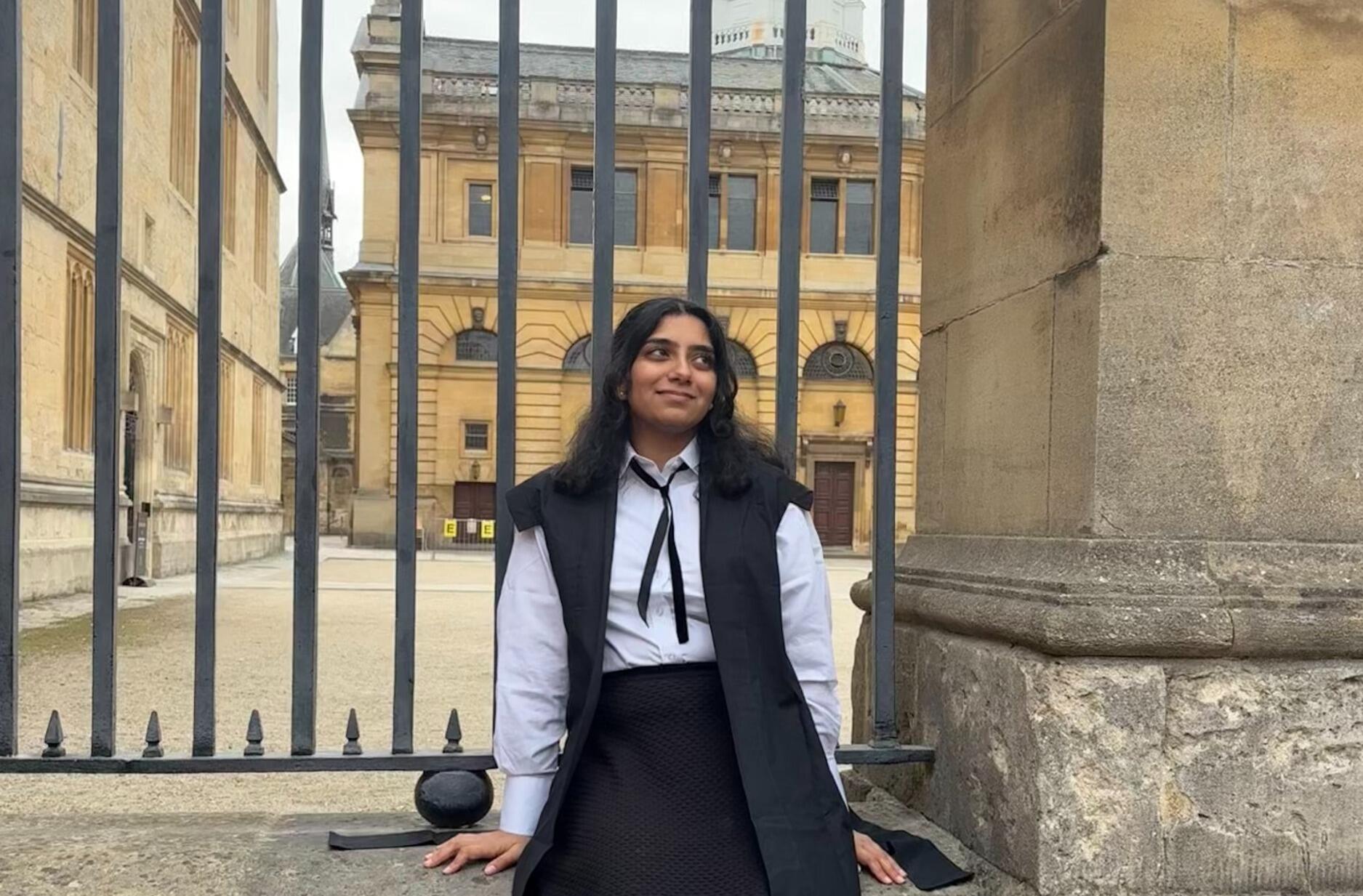
Shrivastava, a Herndon, Virginia native, returned to VCU and earned a master’s degree in biology, studying with Andrew Eckert, Ph.D., an associate professor in the School of Life Sciences and Sustainability, part of the College of Humanities and Sciences. She developed as a researcher and used the springboard of her experiences at VCU to apply to the prestigious Oxford University, where she is now pursuing a Ph.D. in biology.
As a researcher, Shrivastava said she revels in the work of trying “to find answers to questions that don’t have an answer” while pushing the bounds of discovery.
“I believe that with every answer there are a million more questions, and there is always something to be discovered and looked at,” she said. “My favorite thing about research is that it’s never-ending.”
VCU News asked Shrivastava to share more about what draws her to research and its infinite challenges.
Tell us the focus of your research and why it is important/impactful for all of us.
For my master’s degree, I looked at quantifying and determining future persistence of southwestern white pine trees to future climate conditions, specifically drought, combining both phenotype and genetic data. Many ways to look at adaptation are from a trait perspective, but not many people remember that genetics play a role, so this project not only combined the two, but also showed by how much these traits may need to shift in order for this species to survive, which can be applied not just to conservation but to other species as well to look at similar persistence patterns.
What inspired you to pursue this line of research?
When I was in my gap year between undergrad and graduate school, I really sat and reflected about what I thought was interesting about biology and drew me to that subject, and the biggest thing was how everything came to be. How do we have so much diversity in the world and can we track how that diversity might change over time, especially with how climate is changing so rapidly now? That drew me into evolutionary biology.
I really found my passion in the field and developed an even deeper love for this type of research and answering these types of questions, which I then took with me to Oxford, where I am answering similar questions with phytoplankton evolution.
Tell us about a surprise in your research journey.
I was surprised by how much things can change that you would never plan for. Ending up in this field was not my plan when I first started my undergrad journey, but I am so happy I ended up in the research I am, making that decision to follow my heart and switch to what made me happy. I had already planned to do a Ph.D. eventually when I started research so I was working toward that goal, but even earlier this year, applying to Oxford wasn’t on my list. I decided to, once again, just trust my gut and follow what I wanted, and apply anyways, and now I have the amazing opportunity to study here.
Sometimes, if the opportunity felt right, just taking that leap, whether it be a new idea or switch in the project to applying to a program that seems interesting even if it feels out of reach, may land you on a path you would have never expected or even thought about. If anything, it taught me that it’s OK to not have or follow every little detail, because something new might come along that will be way better than you could ever plan for.
Tell us about an obstacle or challenge you had to overcome in your work.
For me, the most common obstacle was imposter syndrome. It hit me hard, especially in the beginning. I felt like I didn’t belong in this type of research due to never doing it before my master degree. This also fed into my perfectionism, that I felt this desire to “prove” that I belonged there by burning myself out and trying to produce perfect work. With the help of my advisor, he reminded me that in research, there never is a perfect answer, and everyone, including seasoned researchers, feel like they don’t belong sometimes. That's part of the deal when you do research, and it's OK if you do feel that way, but do not let it stop you from pushing forward.
Is there a memorable partnership or lesson you've embraced along the way?
The biggest one is definitely with my mentor. When you have a strong mentor relationship, they will be there to back you up all the way. My mentor, Dr. Eckert, was not only there to help me with the science, but to also give me real perspective of what it will be like in research. Knowing I wanted to do my Ph.D. after my master’s and eventually work toward professorship, he helped me prepare for that with pushing my independence as a researcher but also reminding me to keep a good work-life balance, and letting me have my days when I didn’t feel OK from stress or otherwise without judgment. It was a great combination of pushing me to go beyond where I was, but not so much that I would crash and burn.
What advice would you offer undergrads to kick-start their own research journeys?
I would say take the opportunity, even if you think it won’t work. Don’t be afraid to think outside the box and pitch the idea to someone anyways, or apply to that program even if you don’t think you’ll get in. An idea you have might fit a cool question someone else has, and you might be able to find an interesting idea in the middle. You might never know where that will land you, and it could be something that ends up being the thing you love doing the most.
Subscribe to VCU News
Subscribe to VCU News at newsletter.vcu.edu and receive a selection of stories, videos, photos, news clips and event listings in your inbox.