Feb. 27, 2026
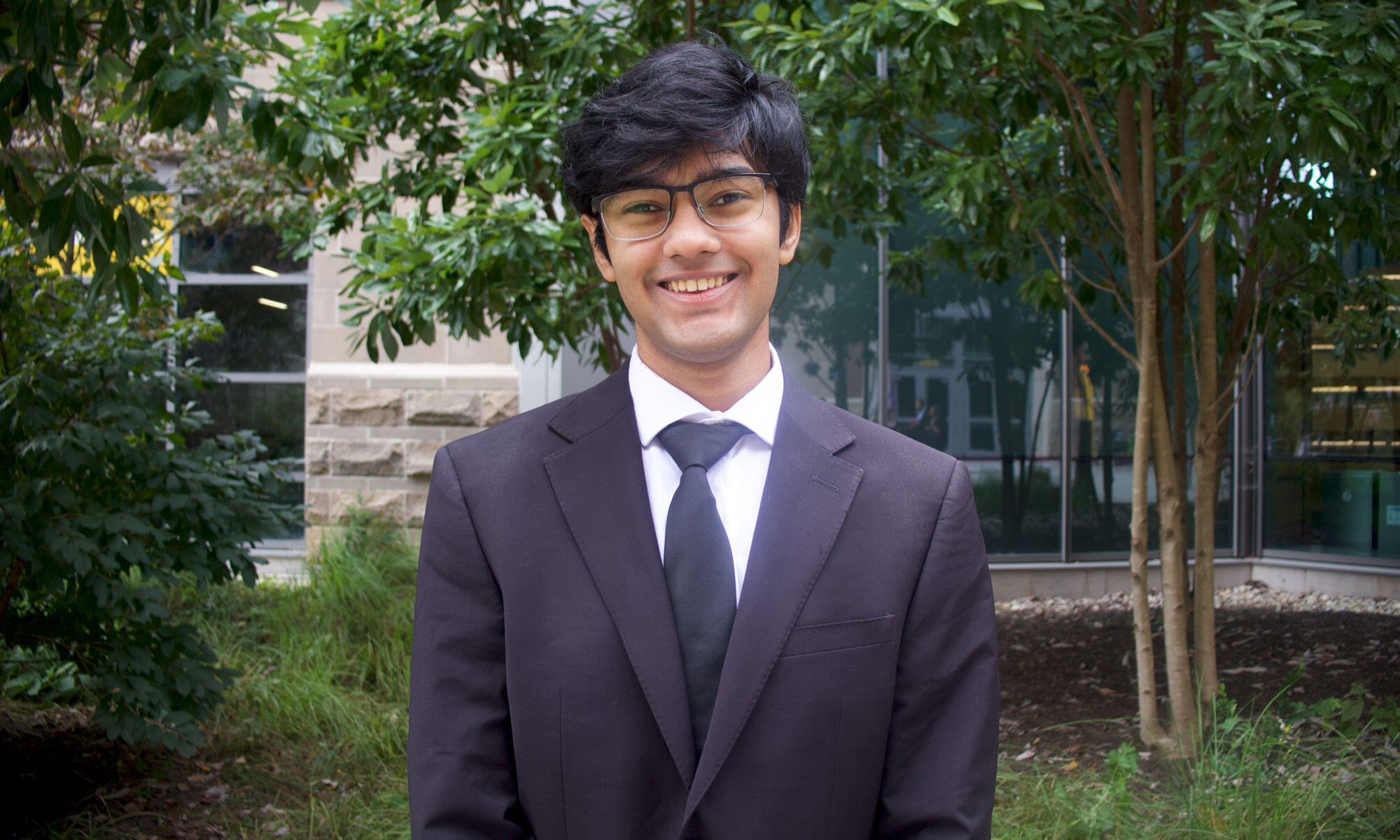
Freshman Sriman Achanta applies AI expertise to real-world research
Share this story
Sriman Achanta is serious about research. At the International Science and Engineering Fair last year, his project employed machine learning to design and test a 3D-printed transradial prosthetic capable of independent finger movement that restores a sense of feeling to the hand. Now a freshman studying computer science at the Virginia Commonwealth University College of Engineering, Achanta is involved in the lab of Ravi Hadimani, Ph.D., associate professor in the Department of Mechanical & Nuclear Engineering and director of the Biomagnetics Laboratory.
Achanta uses his computer programming and artificial intelligence expertise to run head model simulations using the VCU High Performance Research Computing Core facility. The results of his work help scientists understand the effects of Transcranial Magnetic Stimulation on autistic patients by running simulations on the MRIs of nonautistic and autistic patients to derive the magnetic characteristics of each individual.
“Computer programming is a great way to solve problems,” Achanta said. “I’ve been doing it since middle school, but in high school I realized the depth of problems I can solve with just programming is limited. Complex research requires really deep analysis, something AI is great at, so I learned how to apply it in my work.”
The Todd Allen Phillips Center for Medical Sciences at Mills E. Godwin High School in Henrico County cultivated Achanta’s interest in the medical applications of AI, fostered by his teachers and the school’s curriculum. His ISEF project, which earned him third place in the robotics category, was an evolution of work Achanta started through the Center for Medical Sciences.
The Regeneron International Science and Engineering Fair, a program of Society for Science, is the world’s largest STEM competition for high school students. Nearly 2,000 students from nearly every state and more than 60 countries, regions and territories come to Regeneron ISEF to compete for more than $9 million in awards.
“By the time our team got to ISEF, we’d presented about 40 times,” Achanta said. “It made us comfortable enough to tailor the presentation for our audience. For example, presenting to a mechanical engineer, I could highlight details relevant to their experience. At the VCU College of Engineering, this is immensely helpful. I could be working with a researcher who doesn’t know about magnetics or TMS but who does understand mechanical or electrical engineering concepts, so I know to shift our discussion to a perspective they are more familiar with.”
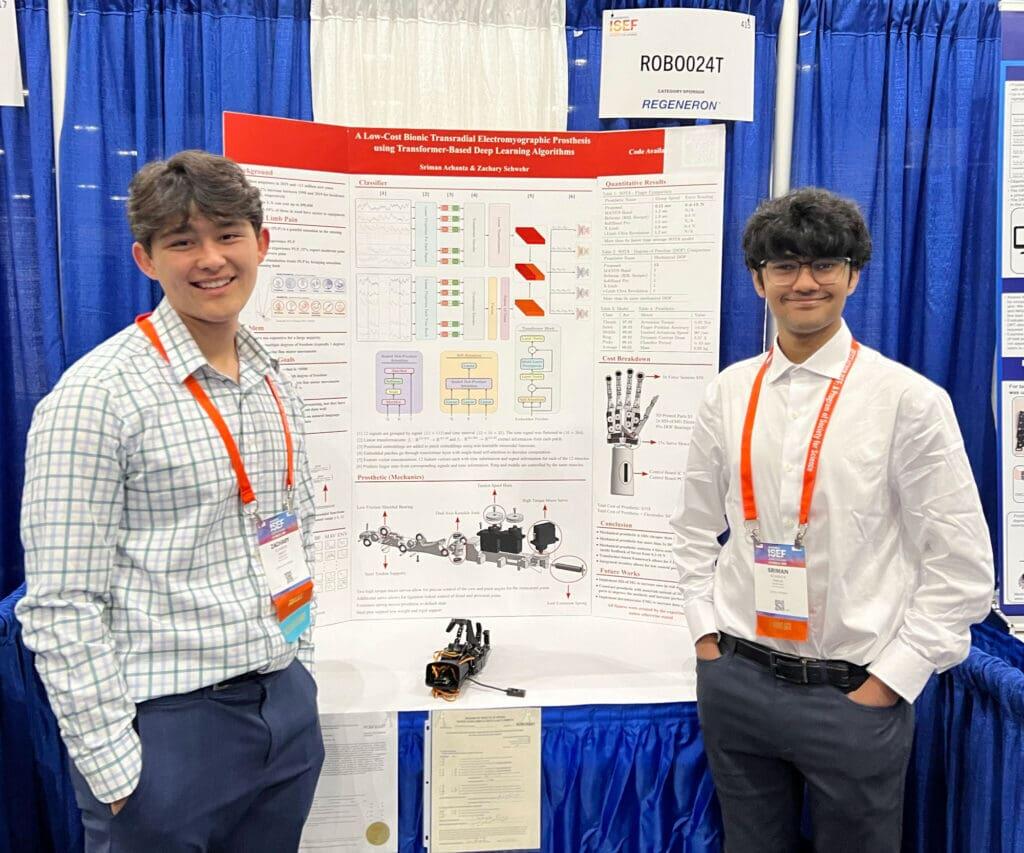
Achanta’s skill with cross-disciplinary collaboration is valuable with another project he’s involved in, the HyperRAMS (Robotics Autonomous and Mechatronics Systems) Vertically Integrated Project. Undergraduate and graduate students from a diverse set of specialties tackle real-world challenges on VIP teams under the guidance of VCU Engineering’s expert faculty.
“The research opportunities that immediately presented themselves, even as a freshman, surprised me,” said Achanta, who grew up in Richmond aware of VCU’s strong research focus. “I was able to schedule a meeting with Dr. Hadimani and leave with an opportunity to work in his lab. I’ve also been fortunate to connect with other researchers, like Dr. Radhika Barua, an assistant professor of mechanical and nuclear engineering, who always gives me excellent advice. It’s faculty like them who make the VCU experience so enjoyable.”
Achanta said he has friends at other universities who are struggling to find research opportunities – some, he said, are not even allowed to conduct research before their second or third year.
“VCU and the College of Engineering do a much better job of trusting students,” he said, “and giving them a chance to take part in important research that’s shaping the future of our world.”
This story was originally published on the College of Engineering website.
Subscribe to VCU News
Subscribe to VCU News at newsletter.vcu.edu and receive a selection of stories, videos, photos, news clips and event listings in your inbox.